The Brownstone Parlor Room Dilemma
- Jan 8
- 6 min read
Updated: Jan 31

The parlor room of a brownstone presents a unique interior design challenge. While intended historically for receiving guests and entertaining, the space is typically long, narrow, and difficult to furnish well. Most parlor rooms measure approximately 12–14 feet wide and 26–33 feet deep, creating proportions that resist conventional living room layouts.

Complicating matters further is the placement of the fireplace. In many brownstones, the fireplace begins roughly seven feet in from the front wall, with the entrance to the parlor directly opposite it. This condition visually and spatially divides the room into an awkward front third and back two-thirds, making it unclear where seating should be placed and how the room should function as a cohesive whole.
Because the parlor room often also accommodates dining due to its proximity to the kitchen, homeowners are left with a persistent question:
If the parlor is meant for entertaining, where should the seating actually go — the front, the center, or the back of the room?
Below are the most common layout approaches, along with their advantages and limitations.
Option 1: Seating in the Front of the Room, Perpendicular to the Room’s Length
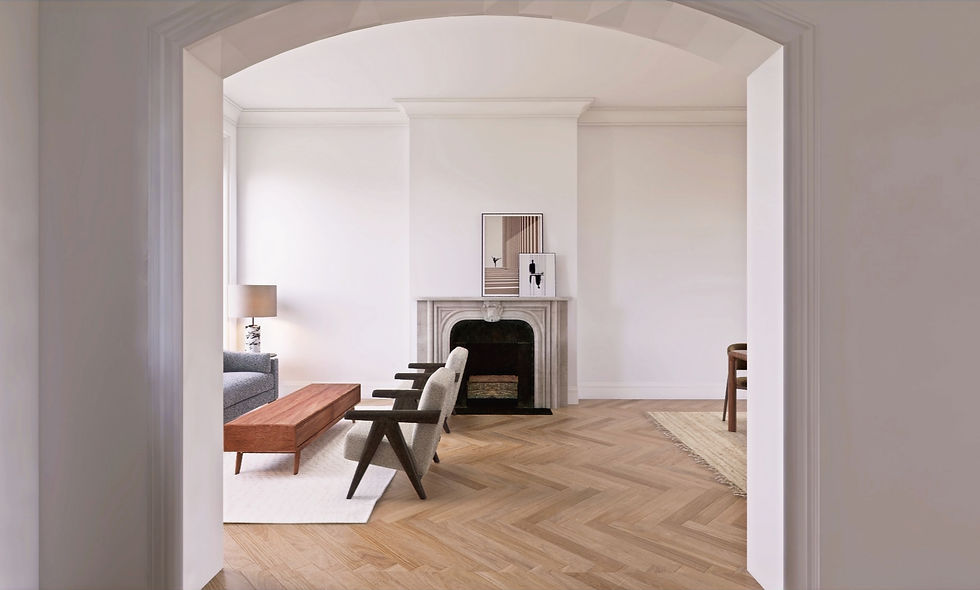
Placing seating perpendicular to the length of the room allows the full width of the parlor to be used for seating, since this area does not sit within the primary circulation path between the entrance and the kitchen.

However, once proper clearances between seating and the coffee table are accounted for, this layout pushes the accent chairs directly in front of the fireplace and the parlor entrance. Even when using shallow seating and a narrow coffee table, the fireplace becomes partially obstructed.
Pros
Does not interfere with circulation between the parlor entrance and the kitchen
Preserves the back of the room for another use
Can accommodate a relatively wide sofa
Cons
Accent chairs obstruct the fireplace
Requires furniture with shallow seats and a narrow coffee table to mitigate the issue
Still compromises the fireplace visually
Option 2: Seating in the Front of the Room, Parallel to the Room’s Length
This arrangement pivots seating so that the sofa sits between the front wall and the fireplace edge. This avoids blocking the fireplace and allows for usage of furniture with deeper seats compared to the first option.

The limitation, however, is room depth. Because this portion of the room is only about seven feet deep, the widest sofa that can fit comfortably is also seven feet. This restricts seating capacity and underutilizes the room’s overall depth.

Pros
Maintains clear circulation from entrance to kitchen
Avoids obstructing the fireplace
Creates a clean division between seating and dining
Cons
Limits the sofa to a narrow three-seater
Uses only a third of the room for its intended purpose
Results in a layout that feels spatially underwhelming
Option 3: Seating Centered Around the Fireplace
Centering the seating area around the fireplace creates a strong visual impression upon entering the room and allows the fireplace to function as a true focal point. It also makes use of the room's depth more effectively than the previous options.

The downside of this arrangement is that it creates an awkward pocket of unused space behind the sofa. The gap measures around 12'6" wide by 4'4" deep making it large enough to look awkward if empty but too small to use meaningfully.

Another drawback is that this arrangement places seating within circulation paths to other parts of the room. This reduces the amount of available room width for seating and makes navigating to other parts of the room more difficult.

Pros
Creates a strong axial view from the foyer
Makes full use of the room’s depth
Is visually the most compelling arrangement
Cons
Leaves unresolved space behind the sofa
Circulation around the seating is tight and uncomfortable
Can only fit up to one table lamp with a full-sized 3 seater sofa
Raises questions about whether sufficient space remains for dining once circulation between the two zones is accounted for
Option 4: Seating in the Back of the Room Along One Side
Seating in the back of the room requires arrangement along one of the walls in order for everyone in the seating area to be close enough to engage in conversation. This last option allows for the largest possible sofa, both in width and in depth, and easily accommodate side tables, multiple lamps, and even media storage if desired.

However the tradeoff is functional. This layout pushes the dining area to the front of the parlor by the windows, placing it a considerable distance away from the kitchen.

Pros
Accommodates a very large, very deep sofa
Still has enough space to support multiple lamps and optional media elements
Does not obstruct the flow of traffic throughout the room
Cons
Dining area sits far away from the kitchen
Better suited to casual living than formal entertaining
The Optimal Brownstone Seating Arrangement
The most effective solution is to center seating around the fireplace using a curved sofa facing away from the windows. Place a console table directly behind the sofa and place lamps on either side.

Why This Works
Curved sofas occupy more depth than rectangular sofas due to their shape (imagine taking a wide rectangular sofa and gently bending it into an arc). The curved back allows part of the sofa’s footprint to extend into the otherwise unused space behind it, reducing the sense of leftover “dead space.”

Instead of placing table lamps or floor lamps beside the sofa, the lighting is relocated behind the seating area, allowing for a much wider sofa, more light, and an intentional use of the residual space.


If You're Currently in the Renovation Stage
If you are currently renovating a brownstone and feeling nervous abou
t furnishing your parlor room, here are some helpful tips that could help you maximize your space:
Remove your parlor doors or opt for pocket doors
Swing doors require a permanent arc of empty floor space in order to open and close. Even when left open these thick doors open inward, consuming 8 or more inches of space next to the wall. If you feel that doors are necessary, pocket doors are a nice option, since they slide into the walls and do not use up room width.
Choose a flush or no outer fireplace hearth
If you plan on centering your seating around the fireplace, a raised outer hearth can interfere with rug placement. A flush hearth allows the rug to extend cleanly to the fireplace wall and be centered to your seating area, creating a more coherent and visually balanced layout.
Widen your parlor entrance
Smaller parlor entrances require making sharp turns when entering the room. Wider entrances allow for diagonal movement when entering and much easier circulation. Larger furniture pieces and more layout options are possible with wider entrances so this is something worth considering.
Consider going Parisian
Brownstones share architectural similarities with Haussmannian apartments—tall vertical windows, high ceilings, hardwood floors, marble fireplaces and heavy moldings. This makes them the perfect backdrop for a Parisian style interior. Consider doing herringbone floors, picture frame molding, and painting your walls white if you want to mimic the look.
About Aetura Studio
Aetura Studio is a remote interior design studio specializing in heritage-inspired spaces for residential clients. Grounded in timeless design and editorial detail, we create spaces that feel layered, elegant, and deeply personal.


Comments